Duncan
The KillerDuncan is the Archduke and king whose authority in Macbett is sustained by military force, public ceremony, and the expectation of obedience. He celebrates victory as the defense of his country and throne, yet treats mass execution as an administrative necessity; crowned in a sacred healing rite, he is then struck down by conspirators who penetrate that ceremony in disguise. His later appearance at Macbett’s feast complicates his image: the murdered ruler admits to his own immense violence even as he confronts the successor who has used Duncan’s name to justify further slaughter.
Identity and Sovereign Authority
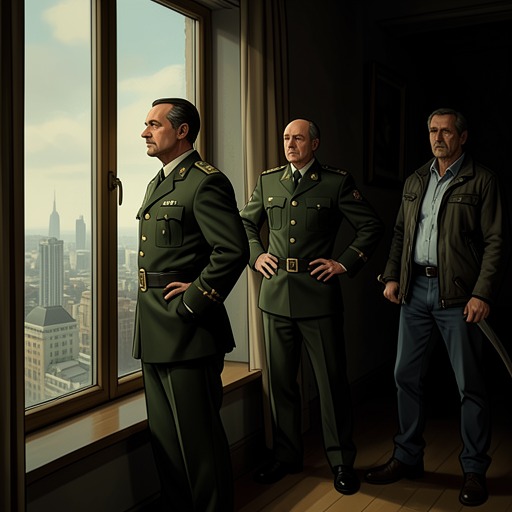
Duncan’s position is made visible through the objects and staging that accompany him. After the battle, an officer brings on a portable throne, and Duncan enters with Lady Duncan amid lavish fanfares. He mounts the seat of power while the others stand beside him. The stage directions give him genuine majesty at the beginning of the later healing scene as well, where the crown, purple robe, and royal scepter mark his sovereignty. His authority is not merely a title: he issues commands to generals, controls the fate of prisoners, and expects his subjects to accept his decisions.
That authority nevertheless depends on a mixture of military success and performance. When Duncan arrives after the fighting, he first asks whether his side has won and whether Candor has been executed or Glamiss killed. The officer cannot confirm that the battle is over; the horizon remains red, and Duncan must wait. He even raises the possibility that Macbett and Banco have been routed. The ruler’s confidence is therefore shadowed by the possibility that his commanders—and the violence they direct—may fail to secure his throne.
Victory, Punishment, and Public Memory
Once Macbett reports that the danger has passed, Duncan learns that Candor has been captured rather than killed. He responds by ordering the prisoner’s beheading and asks again about Glamiss, whom he had wanted torn apart. For Duncan, victory does not conclude the conflict until his enemies have been eliminated. The abruptness of his commands contrasts with the ceremonial language in which he later addresses the surviving soldiers.
Duncan thanks the troops for saving his country and throne, praising both the living and the dead. He imagines the fallen returning to humble villages, lowly hearths, or glorious tombs, and promises that photographs and public remembrance will preserve their example for generations. Yet his account of remembrance folds praise into instruction: the dead are to serve as models for those tempted not to follow orders, while the living are sent back to earn their daily bread under the watchful eye of their masters. The speech transforms military sacrifice into a lesson in continued obedience, even as its grand claims about fame and history sit beside the ordinary labor to which the soldiers are dismissed.
The contrast sharpens when Candor reflects on defeat. Candor calls himself a historical dead end and treats the logic of events as the only logic that counts; he even concludes that the defeated should have sided with whoever proved stronger. Duncan cuts short this reflection and orders Candor and his soldiers executed in the name of justice. The army is said to number 137,000, a figure Duncan dismisses as neither too many nor too few, and he wants the executions finished by dawn. His lofty public praise of posterity thus stands beside a practical command to destroy an enormous defeated force.
Patronage and the Threat of Dissent
Duncan’s treatment of Banco reveals how royal favor can be offered, withheld, and used to contain resentment. Banco has expected a promised reward, whether a title or lands, and protests that Duncan cannot treat him this way. When Duncan enters, however, he presents Banco as a good friend whose nerves are merely unsettled and says that Banco will get his opportunity. This public reassurance does not settle the matter: after Banco leaves, Duncan admits that he should have made him a baron, but adds that the money Banco wanted should rightfully have reverted to the ruler.
The exchange exposes the gap between a sovereign’s language of friendship and his control over reward. Duncan can recognize that Banco has grounds for a title while still treating the financial claim as his own to deny. He also considers Banco’s possible danger, instructing the officer that caution will be necessary if Banco becomes threatening. Macbett tells Banco that other, more forceful arguments may be tried if ordinary appeals fail. In the context of Duncan’s refusal and his command over life and status, that promise of stronger persuasion foreshadows the conspirators’ turn from petition to violence.
The Healing Rite and Assassination
Duncan’s ceremonial authority reaches its clearest expression on the first day of the month, when the sick come seeking cures through his supposedly heavenly gift. A monk blesses the crown, places it on the kneeling Duncan’s head, and confirms his sovereign power in the name of God; Duncan answers with a prayer that he may prove worthy. The scene joins kingship to sacred sanction, while the patients and the ritual make the ruler’s healing role part of the public occasion.
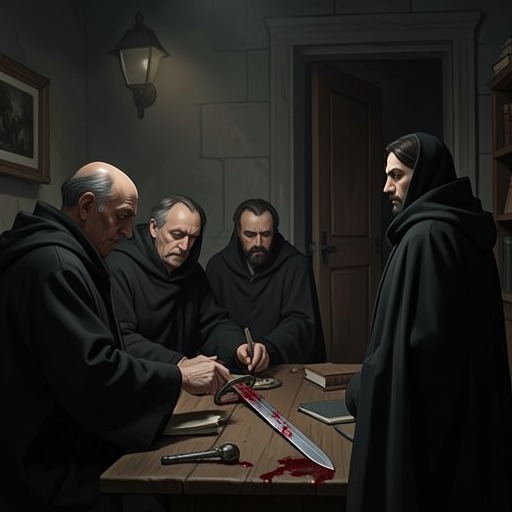
The rite is overturned from within. Two final patients approach under long, hooded capes, and the officer calling the next petitioner fails to notice one creeping up behind him. When the music stops, the monk reveals himself as Banco and draws a dagger. Lady Duncan also casts off her disguise and stabs the officer. Duncan recognizes the two conspirators, but the discovery cannot restore the authority the ceremony had displayed. As he retreats toward the throne, Lady Duncan tears away his cloak; he backs up the steps trying to cover himself. His scepter falls in one direction and his crown in another, while Macbett pulls him down and Banco strikes the first blow. The regalia that had marked his sovereign identity are scattered as his attackers overcome him.
Posthumous Appearance and Political Significance
Duncan appears again after his death, mounting the throne at Macbett’s feast. The guests identify him as the Archduke, while Macbett has just described Banco as little more than the remains of an old personality. Duncan’s return brings the dead ruler into the new regime’s celebration and unsettles its effort to treat the past as finished. Macbett demands that Duncan seek forgiveness from the soldiers slaughtered in his name, and from the women, children, and peasants those soldiers harmed.
Duncan does not deny the charge of violence. He acknowledges that he has killed, or had killed, tens of thousands of men and women, civilians as well as soldiers, and that thousands of homesteads have been burned. His admission prevents the scene from dividing the two rulers into an innocent predecessor and a uniquely guilty successor. Yet Duncan also insists that Macbett has misrepresented one thing: he did not steal his wife. His sardonic retort narrows a vast reckoning over political violence to a personal accusation, while Macbett tells the guests that Duncan’s death has made him mad and they agree. The exchange leaves Duncan both an accuser and a compromised ruler: even in return from death, he can expose the violence of the new sovereign without escaping responsibility for his own.